
RAF Museum London: The Complete History of the Royal Air Force in One Place!

The Royal Air Force Museum London is one of the most important aviation museums in the United Kingdom. It is located in Hendon, on the site of a historic early airfield. The museum was officially opened in 1972 to mark the 50th anniversary of the Royal Air Force. Since then, it has grown into a major national institution. It preserves and presents the history of British aviation and air power. The museum houses over 80 aircraft on display. These range from First World War biplanes to modern jet aircraft. The collection includes iconic planes such as the Spitfire, Hurricane, and Lancaster bomber. Many of these aircraft played key roles in major conflicts. The museum also holds more than a million artefacts. These include uniforms, documents, and personal items. The site is organised into several large hangars. Each hangar focuses on a different theme or historical period. One of the strengths of the museum is its storytelling approach. It combines technical information with personal experiences. Visitors learn about pilots, engineers, and support staff. Interactive displays and multimedia elements enhance the experience. These features make complex topics more accessible. The museum is also known for its large and open exhibition spaces. Visitors can walk around full-scale aircraft and appreciate their size. The historic setting adds authenticity to the visit. The museum stands on ground where aviation history actually took place.

The Royal Air Force Museum London is located on a site of major historical importance in Hendon, North London. This location was once one of Britain’s earliest and most influential aerodromes. Aviation activity at Hendon began in the early 20th century. In 1911, the site was developed by aviation pioneer Claude Grahame-White. He established a flying school and aircraft manufacturing facilities there. This marked the beginning of Hendon’s role in British aviation history. During the First World War, the site became increasingly important. It was used for pilot training and military aviation activities. The rapid expansion of air warfare during this period made Hendon a key location. Aircraft were built, tested, and operated from the area. The presence of the Grahame-White Factory further strengthened its industrial role. In the interwar years, Hendon became famous for its air displays. These events attracted large crowds and showcased the latest aviation technology. The Royal Air Force used the site to demonstrate its capabilities. Hendon was also home to RAF squadrons during this period. It became closely associated with the development of British air power. During the Second World War, the site served as an operational RAF station. It played a role in the defence of London, particularly during the Battle of Britain. Although not a major frontline base, it contributed to the wider air defence network. The site also supported training and logistical functions.
After the war, aviation activity at Hendon gradually declined. Advances in aircraft technology required longer runways and more modern facilities. By 1968, flying operations at the site had ceased completely. This marked the end of its active use as an airfield. The decision was then made to preserve the site’s aviation heritage. It was chosen as the location for the Royal Air Force Museum. Its historical significance made it an ideal setting. The transformation into a museum ensured that its legacy would be maintained.

The Royal Air Force Museum London was officially opened on 15 November 1972 by Queen Elizabeth II, marking the 50th anniversary of the Royal Air Force. The museum was created to preserve and present the history of the RAF and its role in aviation and military development. It is operated by the Royal Air Force Museum, which functions as a national museum and a registered charity. The organisation is also a non-departmental public body, meaning it receives support from the UK government while maintaining a degree of independence. The museum is overseen by a Board of Trustees and managed by a professional team responsible for its collections, exhibitions, and public programmes. The Royal Air Force Museum London regularly also hosts a wide range of special events, experiences, and seasonal activities throughout the year. These events are quite diverse and go beyond standard museum visits. One of the most popular types are interactive experiences, such as flight simulators and cockpit sessions. Visitors can try activities like the Spitfire Experience or a Typhoon flight simulator, which allow them to engage directly with aviation technology. The museum also organises guided tours and themed experiences. These include tours focused on topics such as the Battle of Britain, Bomber Command, the Cold War, or the First World War. These tours provide deeper insight into specific parts of the collection and are often led by knowledgeable guides. Throughout the year, there are also special themed events and weekends. For example, events like D-Day Weekend commemorate historical anniversaries, while others such as Propellers and Popcorn combine aviation with entertainment. Seasonal activities, including holiday-themed events like Easter egg hunts or summer programmes, are also common.

The collection of the Royal Air Force Museum London is notable not only for its historical depth but also for its impressive scale, which can best be understood through key figures and statistics. At the centre of the museum are its aircraft. The London site alone displays more than 80 aircraft, while the total collection held by the museum exceeds 100 airframes. These range chronologically from delicate First World War biplanes to advanced jet aircraft from the Cold War and modern era. However, the aircraft themselves represent only a small portion of the museum’s overall holdings. In total, the museum cares for approximately 1.3 million objects, making it a major archival institution as well as a public exhibition space. These objects include uniforms, medals, personal documents, photographs, and technical equipment. This vast archive allows the museum to present not just the technological evolution of aviation, but also the human stories behind it, pilots, engineers, and ground crew whose experiences shaped the history of the Royal Air Force. In terms of physical size, the museum occupies a substantial area on the former Hendon aerodrome. It is spread across multiple large hangars (around five main exhibition buildings), each designed to accommodate full-scale aircraft. Unlike more compact museums, the RAF Museum benefits from the open spatial layout of a former airfield, allowing large bombers and jets to be displayed with sufficient space for visitors to fully appreciate their scale. This gives the museum a campus-like structure, where movement between hangars is part of the overall experience. The London site attracts approximately 450,000 to 500,000 visitors per year, with some peak years exceeding half a million visitors. When combined with the museum’s Midlands branch, total annual attendance approaches one million visitors. These figures place it among the more popular museums in the United Kingdom, particularly within the category of specialised or thematic museums. Free admission plays an important role in maintaining these high visitor levels, making the museum accessible to a broad audience.
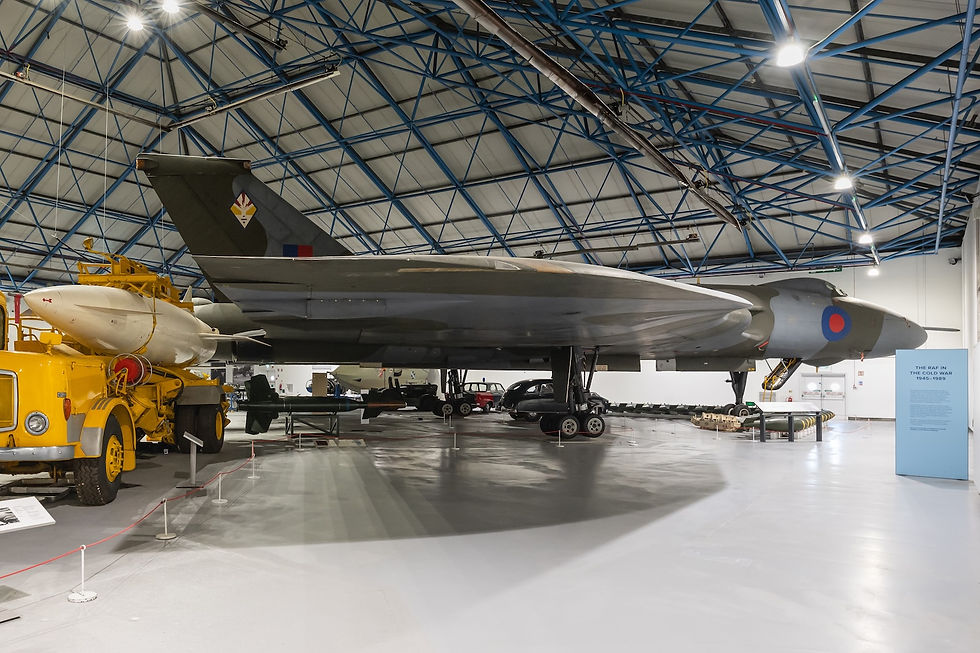
Headliners
Hangar 1: RAF Stories - First to the future!
Hangar 1 at the Royal Air Force Museum London is one of the most modern and conceptually ambitious parts of the museum. It houses the exhibitions RAF Stories and First to the Future. This hangar focuses on the people, missions, and evolving role of the Royal Air Force. It presents a broad narrative that connects past, present, and future. RAF Stories places a strong emphasis on individual experiences. It highlights the lives of pilots, engineers, and support personnel. Visitors encounter personal accounts that reflect the diversity of RAF service. These stories include both men and women from different backgrounds. The exhibition explores themes such as training, daily life, and deployment. It also addresses the challenges faced by RAF personnel. First to the Future shifts the focus toward innovation and forward-looking themes. It examines how the RAF continues to evolve in response to new challenges. Topics such as space operations, cyber warfare, and unmanned systems are introduced. This reflects the expanding role of air forces in the modern world. The exhibition highlights cutting-edge technology and strategic thinking. It shows that the RAF is not only shaped by its past but also actively shaping the future.

One of the centerpieces of Hangar 1: the Blue Steel nuclear armed missile - Credit: Kris Christiaens Hangar 2: First World War in the Air The Grahame-White Factory at the Royal Air Force Museum London is one of the most historically significant parts of the museum. It houses the First World War in the Air exhibition, which focuses on the origins of military aviation. The building itself dates back to the early 20th century. It was originally part of the aviation enterprise founded by Claude Grahame-White. During the First World War, it became a major centre for aircraft production. The factory played a crucial role in supporting Britain’s war effort. Hundreds of workers were employed there to build and maintain aircraft. The adjacent Watch Office served as the administrative heart of the site. After the war, the building went through several different uses. It eventually fell into disrepair before being restored. The museum carefully reconstructed and preserved it as a historical exhibit. Today, it provides an authentic setting for the First World War gallery. The gallery displays around a dozen historic aircraft. These include both British and German designs. Examples such as the Sopwith Camel and Fokker D.VII highlight technological differences. Many of the aircraft are rare or reconstructed using original parts. This adds to their historical value and authenticity.

A replica of the Albatros D-V biplane of the German Air Force - Credit: Kris Christiaens Hangar 3 and 4: The Historic Hangars Hangars 3 and 4 at the Royal Air Force Museum London are collectively known as the Historic Hangars. They form one of the central and most historically dense parts of the museum. These hangars focus primarily on the development of military aviation from the interwar period through the Second World War. They present a chronological and thematic exploration of how air power evolved during this critical era. Hangar 3 is particularly associated with fighter aircraft and air defence. It includes the famous Battle of Britain Hall. This section highlights one of the most decisive air campaigns of the Second World War. Aircraft from both Allied and German forces are displayed together. This allows for direct comparison between opposing technologies. Among the most iconic aircraft are the Supermarine Spitfire and the Hawker Hurricane. These planes played a crucial role in defending Britain in 1940. German aircraft such as the Messerschmitt Bf 109 are also represented. Hangar 4 complements this focus by expanding the story of the Royal Air Force. It explores broader aspects of RAF operations and development. This includes not only fighter aircraft but also training, reconnaissance, and support roles. The hangar helps contextualise the aircraft within the wider structure of the RAF. It shows how different types of aircraft worked together in coordinated operations.

The Messerschmitt Bf-109 of the German Air Force - Credit: Kris Christiaens Hangar 5: The Bomber Hall Hangar 5 at the Royal Air Force Museum London is commonly known as the Bomber Hall. It is one of the most visually striking and historically powerful sections of the museum. The hall focuses on the role of bomber aircraft in military history, particularly during the Second World War. It presents both the technological development of bombers and the human experiences connected to them. The scale of the aircraft displayed immediately captures the visitor’s attention. Large bombers dominate the space, emphasizing their physical and symbolic weight. One of the most important aircraft in this hall is the Avro Lancaster. This aircraft was central to Britain’s strategic bombing campaign. The example displayed, known as “S-Sugar,” completed a remarkable number of missions during the war. Its presence highlights both engineering achievement and operational endurance. Other aircraft in the hall include British, German, and American bombers. This allows visitors to compare different design philosophies and capabilities.

The impressive Avro Lancaster World War Two bomber - Credit: Kris Christiaens Hangar 6: RAF in an Age of Uncertainty Hangar 6 at the Royal Air Force Museum London is titled RAF in an Age of Uncertainty. It focuses on the period from the end of the Second World War to the present day. This section explores how the Royal Air Force adapted to a rapidly changing global landscape. It addresses political, technological, and strategic uncertainties that shaped modern air power. The exhibition moves beyond traditional wartime narratives. It examines the RAF’s role during the Cold War and in more recent conflicts. The Cold War forms a major part of the hangar’s narrative. Visitors learn about the constant threat of nuclear conflict. The RAF’s role in deterrence and defence is clearly explained. Aircraft from this period illustrate advances in speed, altitude, and weapon systems. Jet technology becomes a central theme in this section. The transition from propeller-driven aircraft to jets is presented in detail. This highlights a major shift in aviation engineering. Hangar 6 also explores the RAF’s involvement in international operations. These include conflicts, peacekeeping missions, and humanitarian efforts. The exhibition shows how the RAF became a global force. It highlights cooperation with allies and participation in multinational operations. This reflects the changing nature of warfare in the late 20th and early 21st centuries.

The Blackburn Buccaneer British carrier-capable attack aircraft - Credit: Kris Christiaens
Overview of most important aircraft and helicopters on display
Albatros D-V (German Air Force)
Airco DH-9 (Royal Air Force)
Avro 504 (Royal Air Force)
Avro Lancaster B1 (Royal Air Force)
Avro Vulcan B.2 (Royal Air Force)
Bleriot XXVII
Boeing B-17G Flying Fortress (USAF)
Bristol 156 Beaufighter (Royal Air Force)
British Aerospace Harrier GR9 (Royal Air Force)
Bristol Belvedere (Royal Air Force)
Caudron G3 (Royal Air Force)
Consolidated B-24L Liberator (Royal Air Force)
English Electric Canberra PR3 (Royal Air Force)
Fairey Battle Mk.I (Royal Air Force)
Focke-Wulf Fw-190 (German Air Force)
Fokker D.VII (German Air Force)
Gloster Meteor (Royal Air Force)
Hawker Hart (Royal Air Force)
Hawker Hunter FGA9 (Royal Air Force)
Hawker Siddeley Buccaneer S2B (Royal Air Force)
Hawker Siddeley Gnat T.1 (Royal Air Force)
Hawker Tempest TT5 (Royal Air Force)
Heinkel He 111 (German Air Force)
Heinkel He 162 Volksjager (German Air Force)
Lockheed 414 Hudson Mk.IIIA (Australian Air Force)
Messerschmitt Bf-109 (German Air Force)
North American B-25 Mitchell (USAF)
Panavia Tornado F3 (Royal Air Force)
Sepecat Jaguar GR1A (Royal Air Force)
Sopwith F-1 Camel (Royal Air Force)
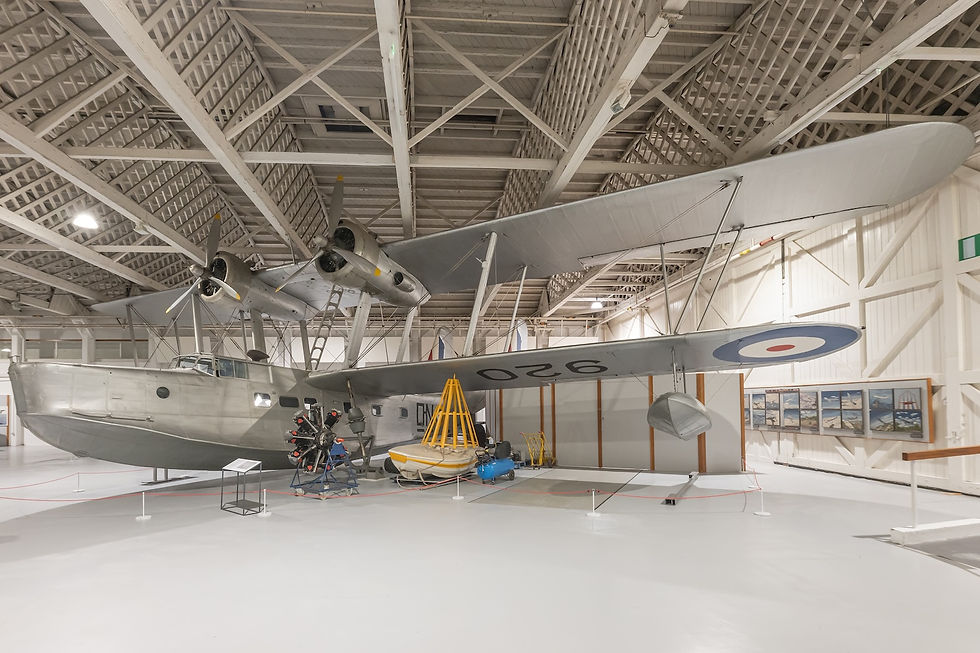
Supermarine Stranraer (Royal Canadian Air Force)
Supermarine Spitfire (Royal Air Force)
Vickers FB-5 Gunbus (Royal Air Force)
Westland Lysander Mk.III (Royal Air Force)
Westland WS-55 Whirlwind (Royal Air Force)
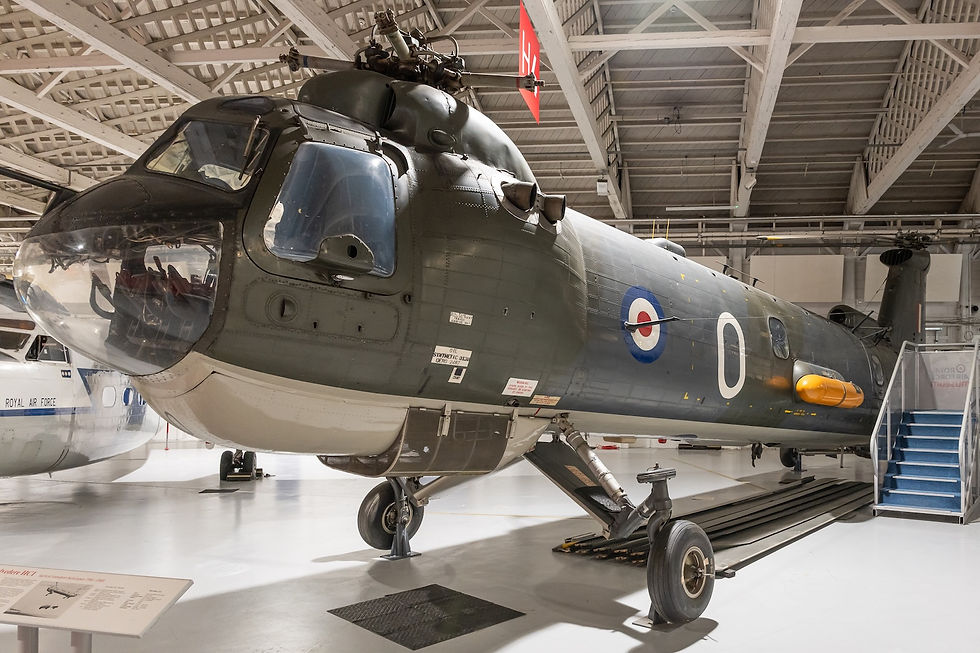
Westland WS-58 Wessex (Royal Air Force)
Why visiting this museum?
Visiting the Royal Air Force Museum London offers a comprehensive journey through more than a century of aviation history. It is one of the few places where the development of military aviation can be understood in a single, coherent setting. The museum presents aircraft not just as machines, but as historical artefacts embedded in broader social and military contexts. Its location on the historic Hendon aerodrome adds an additional layer of authenticity. Visitors are effectively standing on ground that was directly involved in early aviation development. The scale of the aircraft collection is a major reason to visit. With over 80 aircraft on display, the museum provides a rare opportunity to see such a wide range of aviation technology in one place. The museum also excels in storytelling. Each exhibition combines technical information with human narratives. Visitors learn about the experiences of pilots, engineers, and support crews. Interactive and multimedia elements further enrich the experience. Displays include videos, audio recordings, and digital installations. These features help explain complex topics in an accessible way. They also make the visit more engaging for different age groups. Families, students, and enthusiasts can all find content suited to their interests. The museum is also notable for its accessibility. General admission is free, which encourages a wide range of visitors. Its location in London makes it easy to reach by public transport. The layout is designed to accommodate both short visits and more in-depth explorations.
Practical tips
Visiting the Royal Air Force Museum London can be a highly rewarding experience, and a few practical considerations can help make the most of it. First, it is advisable to allocate sufficient time for the visit, as the museum is large and spread across multiple hangars; ideally, visitors should plan for at least three to four hours to explore the main exhibitions without rushing. Because of this scale, it is helpful to plan a general route in advance, either starting with the historic hangars or focusing on specific themes such as the First World War or the Battle of Britain, to avoid unnecessary backtracking. Comfort is also an important factor, as visiting the museum involves considerable walking between different exhibition spaces. Wearing comfortable footwear can significantly improve the experience. Within the museum, visitors should take advantage of the interpretive materials provided, including information panels, audio guides, and multimedia displays, as these add valuable context to the aircraft and artefacts on display. The museum is particularly suitable for families, as it includes interactive exhibits, simulators, and engaging displays that appeal to a wide range of ages. However, supervision is recommended in busier areas, especially with younger children. Visiting on weekdays can also be beneficial, as weekends and public holidays tend to attract larger crowds, which may limit visibility and comfort when viewing popular exhibits. Visitors should also plan for breaks during their visit. The museum provides café facilities and seating areas where guests can rest and recharge before continuing their exploration. Bringing water or light refreshments can be useful, especially during longer visits. Photography is generally permitted in most areas, allowing visitors to capture highlights of the collection, although it is important to follow any posted restrictions regarding flash or specific exhibits.

Transportation tips
Car: For those considering driving, there is parking available at the museum, but spaces can be limited, especially on weekends and during school holidays. Arriving early is recommended if you plan to use the car park. Traffic in North London can also be heavy, so allow extra time for your journey (Grahame Park Way, Hendon, London NW9 5LL)
Public transport: The easiest way to reach the museum is usually by London Underground. The nearest station is Colindale on the Northern Line, which is about a 10–15 minute walk from the museum. The walk is clearly signposted and passes through a residential area, making it simple to navigate even for first-time visitors. Another option is Hendon Central, also on the Northern Line, though it is slightly farther away and may require a bus connection. Buses provide an additional convenient option. Several routes stop close to the museum entrance, including those running along Colindale Avenue. Taking a bus can be especially useful if you want to reduce walking time or if you are travelling with children or elderly visitors. It is advisable to check routes and schedules in advance using apps like Google Maps or Citymapper, which offer real-time updates.
By bike: Cycling is another option, particularly for visitors already in London. There are cycle routes leading toward Hendon, and bike parking is available at the museum. This can be a convenient and flexible alternative, especially in good weather.
Text & photos: Kris Christiaens


Excellent review. Definitely a museum I'd love to visit.