
Flight Gallery at the London Science Museum: Machines That Changed the Sky!

Updated: Apr 18
The Science Museum London is one of the world’s leading institutions dedicated to science, engineering, and innovation. Situated in South Kensington, it forms part of a dense cultural district alongside major museums and research institutions. Among its many galleries, the aviation or “Flight” gallery stands out as a coherent and engaging narrative of humanity’s conquest of the air, combining historically significant aircraft with detailed explanations of the science behind them. The Science Museum London is one of the most visited museums in the United Kingdom, attracting approximately 3.4 million visitors per year in its busiest recent periods. This places it among the top-tier cultural attractions in London, particularly since general admission is free, which helps maintain consistently high attendance levels throughout the year. In terms of scale, the museum complex contains roughly 30,000 to 35,000 square metres of exhibition space, spread across multiple floors and large interconnected galleries. This includes permanent exhibitions, temporary displays, interactive zones, and specialist collections covering fields such as medicine, space, energy, computing, and transport. The Flight gallery itself is a concentrated aviation space within the museum rather than a separate building. It contains approximately 21 full-size aircraft, many of which are suspended from the ceiling to create a layered, three-dimensional display environment. These aircraft span the full timeline of aviation development, from early experimental machines to jet-age designs.
Alongside the aircraft, the gallery features a major collection of aero engines, numbering around 70 or more examples, depending on how individual components and grouped exhibits are counted. These engines are a key part of the gallery’s educational approach, showing how propulsion technology evolved from early rotary engines through high-performance piston engines to early jet turbines.

The origins of the museum can be traced back to the Great Exhibition of 1851, an international exposition that celebrated industrial and technological progress. The success of that exhibition led to the creation of a permanent collection of scientific and industrial objects. The Science Museum formally became an independent institution in 1909, when it separated from what is now the Victoria and Albert Museum. Over the course of the 20th century, it expanded significantly, evolving into a major public resource for science education and historical preservation. The museum’s location on Exhibition Road is itself historically meaningful. The entire area was developed following the Great Exhibition as a center for learning and culture. Unlike older institutions housed in repurposed buildings, the Science Museum largely occupies purpose-built structures constructed in phases throughout the 20th century. This allowed it to adapt to the growing scale and diversity of its collections. Aviation has been part of the museum’s displays since the early 20th century, with aircraft exhibited as early as 1912. The dedicated Flight gallery opened in 1963, reflecting a more modern approach to museum design that emphasized storytelling and education rather than simple display. One of the defining characteristics of the gallery is its use of space. Aircraft are suspended from the ceiling in a layered arrangement, allowing visitors to view them from multiple angles and understand their shapes and proportions in three dimensions. This presentation is not merely aesthetic; it reinforces the engineering narrative by making features such as wing design, fuselage streamlining, and control surfaces clearly visible. The gallery is arranged broadly in chronological order, guiding visitors through the evolution of flight as a sequence of technical problems and solutions.

Headliners
Vickers Vimy Among the most historically important aircraft on display is the Vickers Vimy. The Vickers Vimy suspended in the Flight gallery of the Science Museum London tells a story that begins in the final phase of the First World War. Designed as a heavy bomber, it was intended to strike targets deep within enemy territory, reflecting the growing importance of long-range air power. Its structure was typical of the era, built from a wooden frame braced with wires and covered in fabric, yet it was remarkably large for its time. Powered by two Rolls-Royce Eagle engines, the aircraft combined reliability with sufficient power to carry heavy loads over long distances. Although it arrived too late to see significant combat in the war, its true historical significance emerged in the years that followed. In 1919, the Vimy was selected for an ambitious attempt to cross the Atlantic Ocean without stopping, a feat that had never been accomplished by air. Pilots John Alcock and Arthur Brown prepared the aircraft for the journey, modifying it to carry extra fuel and essential navigation equipment. The flight began in Newfoundland, where the aircraft took off heavily laden and struggled to gain altitude. Throughout the journey, the crew faced extreme cold, icing conditions, and near-zero visibility, forcing them to rely on basic instruments and dead reckoning. At times, the aircraft flew dangerously close to the ocean surface, its engines laboring under the strain of the long flight. Despite these challenges, the Vimy demonstrated remarkable endurance and stability, qualities that were not guaranteed in early aviation. After more than 16 hours in the air, Alcock and Brown successfully landed in Ireland, completing the first non-stop transatlantic flight. This achievement marked a turning point in aviation history, proving that aircraft could connect continents and shrink the world. The Vimy thus transitioned from a military design into a symbol of peaceful progress and global connectivity. The aircraft now displayed in London represents this transformation, preserved as a milestone in engineering and exploration. Visitors standing beneath it can see the large wingspan and simple construction, which contrast sharply with modern aircraft. Its exposed framework and minimal instrumentation highlight the risks taken by early aviators.
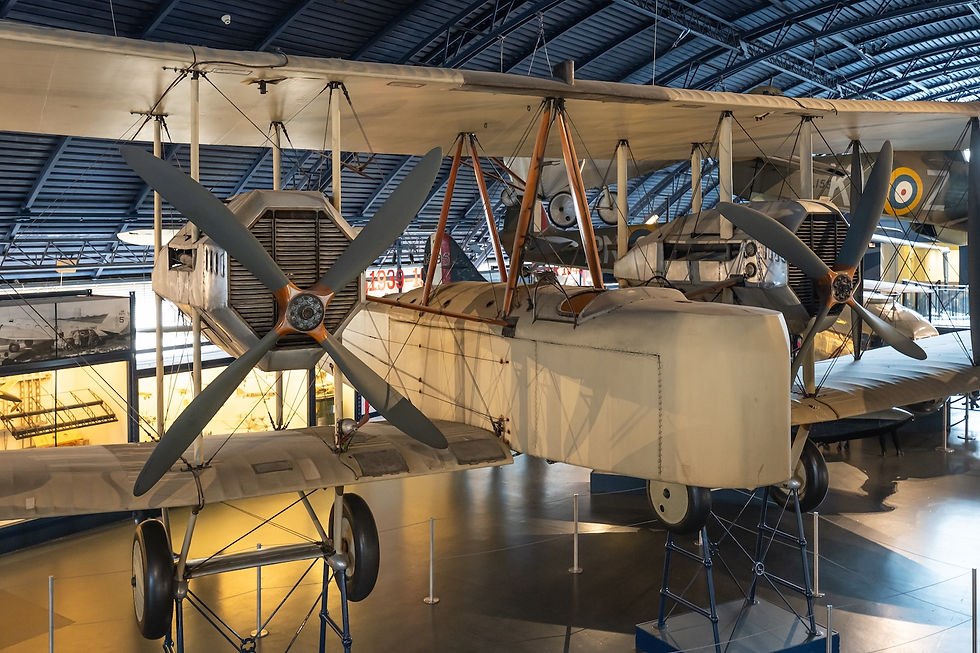
The Vickers Vimy biplane - Credit: Kris Christiaens Supermarine S.6 The Supermarine S.6B displayed in the Flight gallery of the Science Museum London embodies the intense pursuit of speed that defined interwar aviation. Developed for the prestigious Schneider Trophy races, it was designed not for combat or transport, but purely to push the limits of aerodynamic performance. Its sleek, streamlined fuselage and slender floats were shaped to reduce drag as much as possible, reflecting a new scientific approach to aircraft design. At its heart was the powerful Rolls-Royce R engine, capable of producing extraordinary horsepower for its time. This engine allowed the aircraft to reach speeds exceeding 400 miles per hour, a remarkable achievement in the early 1930s. The S.6B represented the culmination of a series of racing seaplanes, each iteration refining aerodynamics, cooling systems, and structural strength. Cooling the engine was itself a major challenge, leading engineers to integrate radiators into the aircraft’s surface to minimize drag. The aircraft’s success in the Schneider Trophy secured Britain’s permanent possession of the trophy and demonstrated national technological leadership. More importantly, the lessons learned from the S.6B directly influenced the development of later aircraft, including the famous Spitfire. Standing beneath it in the museum, visitors can appreciate how compact and purpose-built it is, with every element optimized for speed. Its elegant form reflects both engineering precision and a sense of daring ambition. Today, the Supermarine S.6B serves as a reminder that the quest for performance in competitive aviation helped lay the foundations for modern high-speed flight.

The Supermarine S.6 single-engined single-seat racing seaplane - Credit: Kris Christiaens Gloster E.28/39 The Gloster E.28/39 displayed in the Flight gallery of the Science Museum London represents one of the most decisive technological turning points in aviation history. Developed during the early years of the Second World War, it was Britain’s first jet-powered aircraft and a direct product of the pioneering work of engineer Frank Whittle. At a time when most aircraft relied on piston engines and propellers, the E.28/39 introduced an entirely new method of propulsion based on jet thrust. Its compact fuselage was designed primarily to house the experimental turbojet engine rather than to carry weapons or heavy payloads. The aircraft’s Power Jets W.1 engine worked by compressing air, mixing it with fuel, and igniting it to produce a high-speed exhaust stream that generated thrust. This principle eliminated the need for a propeller and allowed for smoother, potentially faster flight at higher altitudes. The E.28/39 first flew in May 1941, marking a quiet but revolutionary milestone in aviation. Although its performance was modest compared to later jets, it proved that jet propulsion was not only feasible but practical. Test flights revealed new challenges, including high fuel consumption, heat resistance issues, and the need for advanced materials. Despite these limitations, the aircraft demonstrated a level of mechanical simplicity compared to complex piston engines with many moving parts. Its success paved the way for more advanced jet fighters such as the Gloster Meteor, which would enter service before the end of the war. The E.28/39 itself was never intended for combat, serving instead as a flying laboratory for testing and refinement. Today, its relatively small size and understated appearance contrast with the magnitude of its historical importance. Suspended in the gallery, it symbolizes the moment when aviation shifted from propeller-driven flight to the jet age.

The Gloster E.28/39 was the first British turbojet-engined aircraft -Credit: Kris Christiaens Hawker Siddeley P11.27 The Hawker Siddeley P.1127 displayed in the Flight gallery of the Science Museum London represents one of the most innovative breakthroughs in post-war aviation. Developed in the late 1950s and early 1960s, it was designed to solve a fundamental limitation of conventional aircraft: the need for long runways. At the height of the Cold War, military planners feared that airbases could be easily destroyed, making runway-independent aircraft highly desirable. The P.1127 was the experimental platform created to test the concept of vertical or short take-off and landing, known as VTOL. Its most distinctive feature was the revolutionary Pegasus engine, developed by Bristol Siddeley, which used vectored thrust to direct engine exhaust downward for lift. This system employed four swiveling nozzles that could be rotated in unison, allowing the aircraft to transition from vertical lift to forward flight. The engineering challenge was immense, as it required precise control of thrust balance to maintain stability during hover. Early test flights demonstrated that the aircraft could indeed rise vertically, hover, and then accelerate into conventional flight. Pilots had to develop entirely new flying techniques, as controlling the aircraft in hover was more like balancing than traditional piloting. The P.1127 also revealed issues such as hot gas re-ingestion, where exhaust gases could be drawn back into the engine, reducing efficiency. Despite these challenges, the aircraft proved that vectored thrust was a viable solution for VTOL operations. Its success led directly to the development of the Kestrel and ultimately the Harrier, the world’s first operational vertical take-off jet fighter. The aircraft on display captures this experimental phase, with its relatively simple structure compared to later operational jets. Suspended in the gallery, it illustrates a moment when engineers redefined what an aircraft could do, breaking free from the constraints of traditional runway operations.

The Hawker Siddeley P-1127 experimental and development aircraft that led to the Hawker Siddeley Harrier - Credit: Kris Christiaens Aircraft engines
A major strength of the Flight gallery is its extensive collection of aircraft engines, which are displayed alongside the aircraft themselves. The aircraft engines displayed in the Flight gallery of the Science Museum London form a chronological story of how humanity learned to generate controlled, sustained power for flight. The earliest engines in the collection are lightweight rotary designs, where the entire cylinder block rotated with the propeller to improve cooling, as seen in early World War I-era powerplants. These engines were mechanically simple but inefficient, often producing limited power while suffering from strong gyroscopic forces that affected aircraft handling. As aviation demands increased, inline and radial piston engines emerged, offering higher reliability and more stable performance for longer flights. Many of these interwar engines introduced supercharging, allowing aircraft to maintain power at higher altitudes where air density drops significantly. This transition in engine design enabled aircraft like record-breaking racers and long-distance pioneers such as the Vickers Vimy to achieve feats once thought impossible. During the 1930s and Second World War era, engine technology rapidly advanced, with multi-cylinder piston engines producing thousands of horsepower for fighters and bombers. These engines became more complex internally, with improved fuel injection systems, stronger alloys, and refined cooling methods to handle extreme stress. A major shift in the story comes with the introduction of early turbojet engines, which abandoned propellers entirely in favor of continuous combustion and exhaust thrust. These jet engines, associated with aircraft like the Gloster E.28/39, represent a fundamental change in propulsion philosophy rather than just incremental improvement. Cutaway displays and exposed components in the gallery reveal compressors, combustion chambers, and turbines, making visible the internal logic of jet propulsion for visitors. Together, the engines in the museum show a clear progression from fragile mechanical systems to high-speed thermodynamic machines that define modern aviation.

Aviation engines at the Science Museum in London - Credit: Kris Christiaens
Why visiting this museum?
Unlike many aviation museums that focus on quantity, this gallery emphasizes key breakthroughs and explains them clearly. Visitors can follow the evolution of aircraft from fragile early machines to advanced jet-powered designs. The displays show not only what changed in aviation, but why those changes were necessary. Iconic aircraft such as the Vickers Vimy illustrate the moment when long-distance flight became possible. High-speed innovation is represented by aircraft like the Supermarine S.6B, demonstrating the pursuit of performance. The transition to the jet age is captured by the Gloster E.28/39, showing a major leap in propulsion technology. Visitors can also explore experimental designs such as the Hawker Siddeley P.1127, which redefined how aircraft operate. The gallery includes a large and informative collection of aircraft engines, allowing visitors to understand how propulsion evolved. These engines are displayed in a way that makes technical comparisons easy and accessible. The presence of a Boeing 747 cross-section helps connect historical aviation to modern air travel. Visitors can see how aircraft are structured internally, from passenger cabins to cargo areas. The gallery explains complex principles like lift, drag, and thrust in a clear and engaging way. It is therefore both educational and visually impressive. Aircraft suspended from the ceiling create a strong sense of scale and immersion. The layout allows visitors to view aircraft from multiple angles, enhancing understanding of their design. Personal artifacts and pilot equipment add a human dimension to the technical displays. The gallery appeals to both casual visitors and those with a deeper interest in engineering or aviation. It provides historical context while also highlighting innovation and experimentation. Overall, the Flight gallery offers a rare combination of education, history, and visual impact, making it a highly rewarding experience.

Overview of most important aircraft and helicopters on display
Avro 504 (Royal Air Force)
Blériot XI
Cody C Military Biplane
de Havilland D.H. 60 Gipsy Moth
de Havilland D.H. 125
Gloster E28/39 (Royal Air Force)
Handley Page HP.39 Gugnunc
Hawker Hurricane (Royal Air Force)
Hawker Siddeley P-1127 (Royal Air Force)
Lockheed 10 Electra
Messerschmitt Me-163 Komet (German Air Force)
Royal Aircraft Factory SE-5
Saunders-Roe Skeeter (Royal Army)
Supermarine S.6B (Royal Air Force)
Vickers FB-27 Vimy
Practical tips
The museum can become very crowded, particularly on weekends and school holidays. Arriving early in the morning or later in the afternoon gives you more space and time to explore the Flight gallery without rush. If aviation is your priority, head directly there when you enter. It tends to fill up later in the day, and viewing suspended aircraft is much easier before crowds gather underneath them. Many of the most important aircraft are suspended overhead. Take time to step back and observe from different angles, as this reveals details in wing shape, engine placement, and structure. The gallery includes elevated walkways. These allow closer views of aircraft like the Vickers Vimy and Supermarine S.6B, which you cannot fully appreciate from the ground floor. The engine displays are easy to overlook but are essential for understanding aviation development. Compare early piston engines with jet engines to see how propulsion evolved. The museum is large, so plan a route. Pair the Flight gallery with “Exploring Space” or “Making the Modern World” to see how aviation fits into broader technological progress. Admission is free, so you don’t need to see everything in one visit. If you feel overloaded, focus on key areas and return another day. Photography in the Flight gallery of the Science Museum London is generally permitted and is one of the reasons many visitors bring a camera or smartphone. The suspended aircraft, large open hall, and dramatic lighting make it a visually strong environment for photography, especially for aviation subjects.

In practical terms, you can freely photograph most aircraft, engines, and exhibits for personal use. There is no general requirement for permits or fees for standard visitor photography. However, commercial photography or professional shoots would require prior permission from the museum. Lighting is one of the main technical challenges. The gallery uses controlled, relatively dim lighting to both protect the exhibits and create a theatrical atmosphere. This means that cameras often need higher ISO settings or slower shutter speeds than in brightly lit museums. The elevated walkways provide some of the best photographic opportunities in the gallery. From these angles, visitors can capture more detailed views of wings, fuselages, and structural elements that are difficult to appreciate from ground level. These vantage points also help reduce crowd interference in shots. Crowd management is another important factor. Composition is particularly important in this space. Many aircraft, such as the Vickers Vimy, are suspended high above visitors, meaning wide-angle shots are often necessary to capture their full form. Standing farther back in the hall usually produces better framing, especially for larger aircraft that span significant portions of the ceiling. The gallery can become very busy, especially around central exhibits. Early morning visits are ideal for clean shots without people in the frame, while midday tends to produce the most congestion directly beneath major aircraft displays.

Transportation tips
Public transport: The Science Museum London, located in South Kensington, is very easy to reach using public transport due to its position in one of London’s main museum districts. The most convenient station is South Kensington Underground Station, which is served by the Circle, District, and Piccadilly lines. From this station, visitors can reach the museum in about 5 to 10 minutes on foot. The walk is straightforward and well signposted, with a direct pedestrian subway leading under the busy road network and bringing you out close to Exhibition Road, where the museum is located. This is the most commonly used route and the one designed for the majority of visitors. Another nearby option is Gloucester Road Station, also served by the Circle, District, and Piccadilly lines. The walk from here takes roughly 10 to 15 minutes and is often less crowded than South Kensington, making it a good alternative during peak visiting times. The route is simple and passes through residential streets leading toward the museum district. Knightsbridge Station on the Piccadilly Line can also be used, though it is further away at around 15 to 20 minutes on foot. This route is sometimes chosen by visitors approaching from Hyde Park or central London shopping areas, as it offers a more scenic walk through the surrounding district. In addition to the Underground, several London bus routes stop close to the museum or along Exhibition Road. These include routes such as 14, 49, 70, 74, 345, 360, 414, and C1. Bus stops are located within a short walking distance of the entrance, making buses a flexible alternative if you prefer surface transport.
Text & photos: Kris Christiaens


Comments