
Nationaal Militair Museum Soesterberg: From Airfield to World-Class Museum!

Updated: Dec 18, 2025
The Nationaal Militair Museum (NMM) at the former Soesterberg Air Base is the Netherlands’ flagship military history museum and, for anyone with a serious interest in aircraft and military aviation, a must-see. Under a single, expansive roof the museum combines large, hangar-scale displays with curated, story-driven galleries. The result is a venue that simultaneously satisfies the “aircraft geek” desire to get close to iconic machines and the “history buff” desire to understand how those machines were used, developed and integrated into Dutch and international defence. If you want a textbook example of what a museum should look like to make it attractive to visitors, you should definitely visit the NMM. Both young and old can learn all about the rich military history of the Netherlands here.

The Nationaal Militair Museum (NMM) occupies a large site of approximately 45 hectares on the former Soesterberg Air Base, including the main museum building and outdoor areas. The main museum building itself is notably large, with a steel roof approximately 110 by 250 metres, creating column‑free exhibition halls capable of displaying aircraft, helicopters, and large military vehicles together. The museum building was designed by the Dutch practice led by Felix Claus and Dick van Wageningen (Felix Claus Dick van Wageningen Architecten) with involvement from exhibition architects and engineering partners for structure and services. The project was notable for its very large, continuous roof and the hangar-scale interior that allows full-size tanks, armoured vehicles and aircraft to be displayed together in a light, open volume. The Nationaal Militair Museum (NMM) was officially opened on 11 December 2014. The opening ceremony was performed by King Willem-Alexander; the institution brought together the collections of the former Legermuseum (Army Museum) and the Militaire Luchtvaart Museum (Military Aviation Museum) into one consolidated, purpose-built facility at Soesterberg. The NMM typically attracts around 250,000–300,000 visitors per year in recent (pre‑pandemic and post‑pandemic) seasons. In 2019, it saw approximately 267,000 visitors. In late 2023 the museum celebrated its 300,000th visitor of the year, indicating that annual attendance in recent seasons has been approaching or exceeding 300,000 visitors. During its first year after opening in 2014–2015, the museum drew more than 500,000 visitors, placing it among the most visited museums in the Netherlands at that time.

Headliners
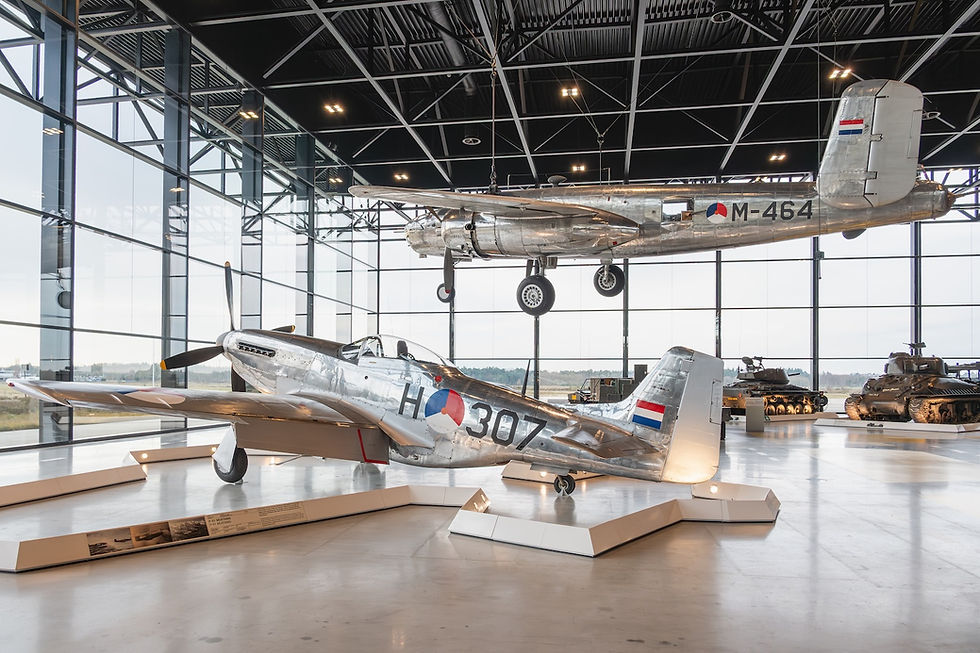
Fighter jets For aviation enthusiasts, the fighter jet collection at the Nationaal Militair Museum (NMM) is one of its strongest draws. Displayed in the vast central hall and associated galleries, the museum’s fighters illustrate the evolution of air combat from the early jet age through the Cold War and into the modern multirole era, with a clear emphasis on aircraft that served with the Royal Netherlands Air Force or operated from Dutch soil. Among the most historically significant jets on display is the Gloster Meteor, the first operational jet fighter of the Royal Netherlands Air Force. As a representative of the immediate post–Second World War transition from piston-engine fighters to jet propulsion, the Meteor marks a pivotal technological shift and provides valuable insight into early jet operations, training, and limitations. The Republic F-84F Thunderstreak (and related reconnaissance variants such as the RF-84F) represents the Cold War fighter-bomber era. Operated extensively by the Netherlands within the NATO framework, the F-84F reflects the period when tactical nuclear strike, low-level attack, and alliance interoperability dominated fighter doctrine. Moving into the late Cold War, visitors can see fighters associated with the Northrop NF-5, a lightweight supersonic fighter that served as a mainstay of the RNLAF from the 1970s onward. The NF-5 is especially relevant in a Dutch context, as many airframes were license-built by Fokker, highlighting the national aerospace industry’s contribution to NATO air power. The modern era is represented by the General Dynamics F-16 Fighting Falcon, arguably the most iconic fighter in Dutch service. The F-16 display allows visitors to appreciate how multirole capability, advanced avionics, and high agility transformed fighter operations from the late Cold War into the 21st century. In addition to Dutch-operated aircraft, the museum also displays a McDonnell Douglas F-15 Eagle in United States Air Force markings, reflecting Soesterberg Air Base’s long-standing role as a NATO hub and a former USAF deployment location.

The F-16 fighter jet of the Royal Netherlands Air Force - Credit: Kris Christiaens 
The Gloster Meteor - Credit: Kris Christiaens Helicopters
Alongside its fixed-wing aircraft, the Nationaal Militair Museum (NMM) presents an impressive overview of military helicopter operations, reflecting how rotary-wing aviation became indispensable to the Dutch armed forces. One of the earliest rotary-wing types on display is the Sud-Aviation Alouette II, a landmark helicopter in Dutch service. As one of the first turbine-powered helicopters used by the Royal Netherlands Air Force and Army Aviation, the Alouette II symbolises the post-war breakthrough of practical military helicopter operations, particularly in observation, training, and casualty evacuation roles. Closely related is the Alouette III, a far more capable and versatile development that became one of the most recognisable helicopters in Dutch military service. The Cold War and post-Cold War army aviation era is represented by helicopters such as the MBB Bo 105. This agile, light helicopter played an important role in reconnaissance and anti-tank operations, particularly within NATO’s Central European defence planning. Modern Dutch helicopter operations are highlighted by the Boeing AH-64 Apache, the Netherlands’ primary attack helicopter. In the heavy-lift and transport category, the museum features the Boeing CH-47 Chinook, a key asset of the Royal Netherlands Air Force. The Chinook’s size and tandem-rotor configuration make it a striking exhibit, and its presence underlines the importance of air mobility, logistics, and humanitarian support missions in modern military aviation.

The Boeing CH-47 Chinook at the NMM - Credit: Kris Christiaens 
The MBB Bo 105 helicopter - Credit: Kris Christiaens Netherlands Navy
The Nationaal Militair Museum (NMM) also offers a well-considered overview of naval aviation, highlighting the crucial role played by the Royal Netherlands Navy (Koninklijke Marine) in maritime patrol, search and rescue, and anti-submarine warfare. One of the most historically important naval aircraft at the museum is the Dornier Do 24. This robust flying boat is closely associated with Dutch naval aviation before and during the Second World War, particularly in the Dutch East Indies. Designed for maritime patrol and air-sea rescue, the Do 24 gained a strong reputation for seaworthiness and reliability. Representing the Cold War and post-war maritime patrol era is the Breguet Br.1150 Atlantique. Operated for decades by the Royal Netherlands Navy, the Atlantique was a cornerstone of NATO maritime defence, tasked primarily with anti-submarine warfare, maritime surveillance, and reconnaissance over the North Sea and Atlantic approaches. Naval rotary-wing aviation is also an important part of the museum’s collection. The Westland Lynx helicopter, long operated from Dutch frigates and destroyers, represents the shipborne aviation concept that revolutionised naval warfare. Equipped for anti-submarine and anti-surface roles, the Lynx shows how helicopters extended the reach of surface vessels far beyond the horizon, becoming indispensable tools in modern naval operations.

The Dornier Do 24 of the Royal Netherlands Navy - Credit: Kris Christiaens 
The impressive Bréguet 1150 Atlantic of the Royal Netherlands Navy - Credit: Kris Christiaens
Overview of most important aircraft and helicopters on display
Bell 204 (Netherlands Navy)
Boeing CH-47D Chinook (Royal Netherlands Air Force)
Bréguet 1150 Atlantic (Netherlands Navy)
Canadair NF-5B (Royal Netherlands Air Force)
Cessna T-37 Tweety Bird (US Air Force)
Convair F-102 Delta Dagger (US Air Force)
Curtiss Hawk (Netherlands East Indies)
Dornier Do 24 (Netherlands Navy)
Fieseler Fi 103R (German Air Force)
Fokker S-14 Machtrainer (Royal Netherlands Air Force)
Fokker F27 Troopship (Royal Netherlands Air Force)
General Dynamics F-16A (Royal Netherlands Air Force)
Gloster Meteor F8 (Royal Netherlands Air Force)
Grumman S-2 Tracker (Netherlands Navy)
Hawker Hunter F4 (Royal Netherlands Air Force)
Hawker Sea Fury (Netherlands Navy)
Lockheed P-2 Neptune (Netherlands Navy)
Lockheed TF-104G Starfighter (Royal Netherlands Air Force)
McDonnell Douglas F-4E Phantom II (US Air Force)
McDonnell Douglas F-15A Eagle (US Air Force)
Mikoyan-Gurevich MiG-21PFM (Soviet Union Air Force)
North American F-86 Sabre (Royal Netherlands Air Force)
North American F-100D Super Sabre (US Air Force)
North American P-51K Mustang (Netherlands East Indies)
Republic F-84 Thunderjet (Royal Netherlands Air Force)
Sikorsky S-58 (Netherlands Navy)
Sud Alouette III (Royal Netherlands Air Force)
Westland SH-14D Lynx (Netherlands Navy)

Military vehicles
This museum is not only a destination for aviation enthusiasts, it also showcases an extensive collection of land-based military vehicles, ranging from historic armoured cars and tanks to modern mechanised systems. Visitors can explore early armoured vehicles and interwar designs that reflect the Netherlands’ military development before and during World War II. These include light armoured cars and reconnaissance vehicles, which demonstrate how mobility and protection were balanced in early mechanised forces. The museum features a number of WWII-era tanks and artillery tractors, including Allied and Axis designs that played a role in the liberation of the Netherlands. These exhibits provide historical context, showing how Dutch forces adapted foreign technology and operated alongside allied units during the war. A highlight of the collection is the Cold War armoured vehicles, including tanks, APCs (armoured personnel carriers), and reconnaissance vehicles used by the Royal Netherlands Army as part of NATO’s defence posture in Europe. Modern vehicles such as the CV90 infantry fighting vehicle and various logistics and engineering vehicles illustrate current Dutch army capabilities, including mobility, protection, and firepower.

Why visiting this museum?
The Nationaal Militair Museum (NMM) in Soesterberg is more than a collection of military hardware; it is a carefully designed institution that explains how armed forces, technology, and society influence one another. For a broad audience, ranging from aviation enthusiasts to families and historians, the museum offers several compelling reasons to visit. This museum is also simply accessible and engaging. Clear interpretation, interactive elements, and thoughtful exhibition design make complex military and technical subjects understandable without oversimplifying them. As a result, the museum appeals equally to specialists seeking depth and to general visitors looking for an informative and memorable experience. It is also well suited for children and students, and this is one of its strongest qualities. The NMM museum was deliberately designed to be educational and engaging for younger audiences, without diluting historical accuracy or technical depth. The unique location at the former Soesterberg Air Base adds an irreplaceable layer of authenticity. This was an active military airfield for much of the 20th century and a key NATO base during the Cold War. Visiting a military aviation museum on an actual air base strengthens the connection between the exhibits and the real-world operations they represent.
Practical tips
To make the most of a visit to the Nationaal Militair Museum (NMM) in Soesterberg, a bit of planning is worthwhile. The museum is large, and its layout and location reward visitors who arrive prepared. The museum cannot realistically be seen in a short visit. Allocate at least two to three hours for a general visit, and considerably more if you want to read exhibits in depth or focus specifically on aviation. Aviation enthusiasts and students often find that half a day is ideal. Not all aircraft and helicopters are on permanent display at all times. Some items rotate or are temporarily removed for conservation. If you have a specific aircraft you want to see, consult the museum’s website or online collection database before your visit. The museum is located on the former Soesterberg Air Base, which includes surrounding nature areas. If the weather allows, combine your visit with a walk outside to better appreciate the airfield setting and to give children a break between indoor exhibits. A wide-angle lens is essential to capture full aircraft in the hangar-like space, especially large helicopters and transport aircraft. A standard zoom (for example, in the 24–70 mm range) works well for cockpit shots, undercarriage details, and weapons pylons. Telephoto lenses are less critical but useful for isolating details high on the airframes. Many aircraft have glossy paint and can reflect overhead light or surrounding exhibits. Slight changes in shooting angle can dramatically reduce reflections. Exposing slightly for highlights helps preserve detail in light grey or white aircraft finishes, particularly on modern jets. One of the museum’s greatest strengths is the large roof structure and large windows that allows natural daylight into the main hall. This soft, diffuse light is ideal for photographing aircraft and helicopters without harsh shadows. Mid-morning to early afternoon usually provides the most consistent lighting conditions.

Transportation tips
Car: For most visitors, travelling by car is the easiest and most convenient option. The museum is well signposted from major roads in the region, and navigation systems recognise it under “Nationaal Militair Museum Soest.” On-site parking is available close to the entrance, making it particularly practical for families, photographers carrying equipment, and school groups. Parking capacity is generally sufficient, but on busy weekends and during school holidays it is advisable to arrive early.
Public transport: The museum can be reached by train and bus, though this requires some planning. The nearest railway stations are Soest-Zuid and Amersfoort, from where bus connections serve the area around the former air base. From the bus stop, a short walk is usually required. Check routes and timetables in advance, as bus frequency can be limited outside peak hours and on weekends.
Cycling: For visitors staying in the region, cycling is a very pleasant option. The museum is surrounded by forest and nature reserves, and there are good cycling paths leading to the site. Bicycle parking is available near the entrance, and combining a museum visit with a bike ride through the area is popular in good weather.
Text & photos: Kris Christiaens


I visited this museum last year during my summer vacation. Spent a whole day there. Very modern and engaging military history museum.