
Flugausstellung Peter Junior: An Aviation Dreamland in the Hills of Germany!

Updated: Dec 15, 2025
Flugausstellung Peter Junior is a privately owned aviation museum located in the small town of Hermeskeil, in the German state of Rhineland-Palatinate. Unlike large national museums or government-run institutions, this museum is, and always has been, a family-run endeavour: founded and continuously expanded by the family behind it. What began as a private passion project has matured into one of Europe’s richest collections of historic aircraft, helicopters, engines and aviation artifacts, offering a sweep through many decades of flight, from the very early days to Cold War jets and beyond. Spread across several hangars and open fields, this extraordinary collection brings together icons of civil and military flight from both East and West, arranged so closely and accessibly that you can sense their stories before you even read a placard. From massive Cold War helicopters to elegant early jetliners and lovingly preserved propeller classics, the museum offers a rare, panoramic journey through more than eight decades of aviation progress. It’s the kind of place where enthusiasts linger for hours, families explore with wide eyes, and even casual visitors quickly find themselves pulled into the fascination of flight. In short: an unforgettable destination that celebrates the wonder, ambition, and engineering brilliance of human flight.

The history of this museum is a story of passion growing into one of Europe’s most remarkable aviation collections. The museum began in 1973, when aviation enthusiast Leo Junior opened a small exhibition of aircraft in the quiet town of Hermeskeil, not far from the German–Luxembourg border. What started modestly, essentially as a private passion shared with the public, quickly evolved as the Junior family continued to acquire, restore, and display aircraft from around the world. Over the decades, the collection expanded steadily, fueled by the family’s dedication and the increasing global interest in preserving aviation history. Today, the museum remains family-run, preserving the original spirit of personal commitment and hands-on care. From its humble beginnings, the Flugausstellung Peter Junior has grown into a museum of impressive scale. The site now stretches across roughly 80,000 square meters, blending vast open-air displays with large indoor exhibition halls. The collection includes more than 110 aircraft, ranging from delicate early propeller planes to massive Cold War jets, helicopters, and commercial airliners. Alongside these full-size aircraft, the museum houses dozens of engines, intricate cockpit sections, and thousands of technical components, offering a uniquely comprehensive view into aviation engineering. What sets the museum apart is not simply the number of aircraft, but the diversity of them. The collection spans multiple countries, manufacturers, and eras, showcasing machines from both NATO and Warsaw Pact nations, early civilian pioneers, postwar transport aviation, and military aircraft that once patrolled some of the world’s most tense borders. Few museums in Europe provide such a wide chronological and geopolitical cross-section of aviation in one place.
Headliners
Helicopters One of the most fascinating parts of the Flugausstellung Peter Junior museum is its remarkably diverse collection of helicopters. Spread across the museum grounds, these rotorcraft offer an impressive overview of how helicopter technology evolved during some of the most pivotal decades of aviation history. What makes the collection especially compelling is the balance between Western and Eastern designs, machines that once served on opposite sides of the Cold War now displayed together in peaceful silence. This museum has several beautiful historic helicopters, such as the American Brantly B-2 or the Piasecki H-21, the British Bristol Sycamore, and the German MBB Bo 105. You can also admire the impressive Mil Mi-6A, Mi-24P, and Mi-14PL helicopters.

The impressive Mil Mi-6A Soviet helicopter at the Flugausstellung Peter Junior - Credit: Kris Christiaens 
The Kamov Ka-26 helicopter of the German police - Credit: Kris Christiaens Airliners One of the most striking aspects of the this museum is its impressive lineup of large commercial airliners, massive machines that once crossed continents and oceans, now resting in the quiet hills of Hermeskeil. Seeing these giants on the ground, up close, gives visitors a sense of their true scale in a way that airport terminals never allow. The museum’s airliner collection showcases several important chapters of civil aviation history, from the early jet age to the era of high-capacity transcontinental travel. Among the stars of the collection is the imposing Vickers VC10, a rare sight in mainland Europe. This elegant British airliner, famous for its rear-mounted engines and distinctive swept tail, was once a symbol of long-range luxury flight.

The impressive Vickers VC10 - Credit: Kris Christiaens 
The De Havilland D.H. 106 Comet at the Flugausstellung Peter Junior - Credit: Kris Christiaens 
The Soviet designed Ilyushin Il-18 passenger aircraft - Credit: Kris Christiaens Western fighters
This museum has a bunch of great aircraft that were once used by Western countries during the Cold War. You can observe up close a Dassault Mirage IIIR from the French Air Force, a Hawker Siddeley Harrier GR3 from the Royal Air Force, several Lockheed F-104 Starfighters, and various McDonnell Douglas F-4 Phantom IIs from the US Air Force. In addition, you can also admire a Saab Draken and a Saab Viggen up close, and there are three Republic F-84 aircraft on display.
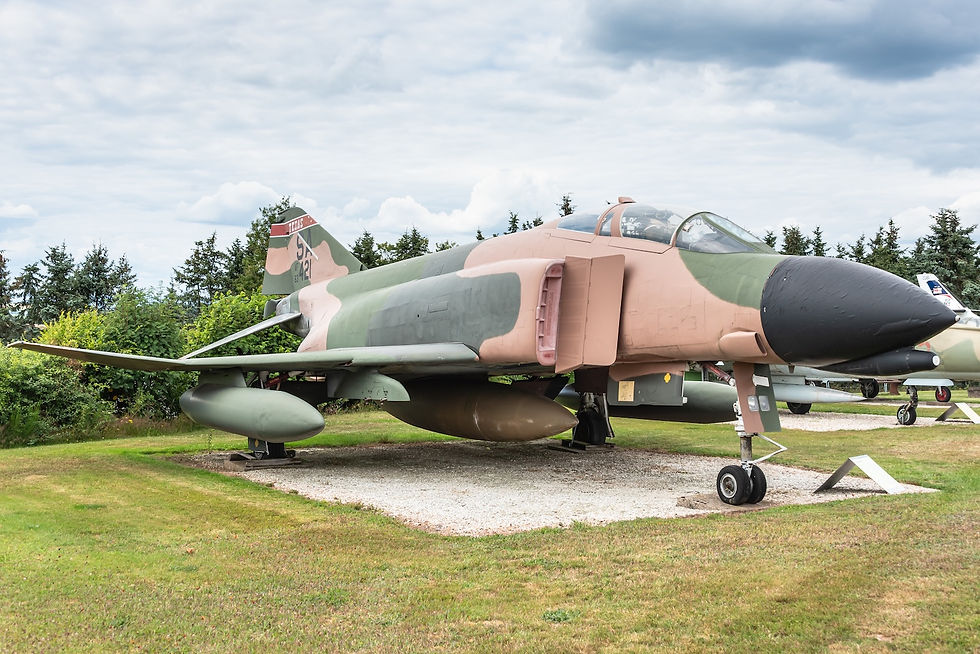
A McDonnell Douglas F-4 Phantom II of the USAF - Credit: Kris Christiaens 
A Dassault Mirage IIIR of the French Air Force - Credit: Kris Christiaens Warsaw Pact aircraft
For fans of aircraft designed by the Soviet Union, this museum is also a true paradise. You can admire no fewer than six Mikoyan-Gurevich MiG-21 fighter jets, as well as several Sukhoi and Antonov aircraft.

A Sukhoi Su-7 of the Polish Air Force - Credit: Kris Christiaens
Overview of most important aircraft and helicopters on display
Antonov An-26T
Brantly B-2
CASA 2.111D (German Air Force)
Convair F-102 Delta Dagger (USAF)
Dassault Mirage IIIR (French Air Force)
Dassault Super Mystere (French Air Force)
De Havilland D.H. 104 Sea Devon (Royal Navy)
De Havilland D.H. 106 Comet (Dan-Air London)
Fairey Gannat (Royal Navy)
Fiat G-91 (Italian Air Force)
Fouga CM-170R Magister (Belgian Air Force)
Hawker Siddeley Harrier GR3 (Royal Air Force)
Lockheed L-1049G Super Constellation (Lufthansa)
McDonnell Douglas F-4 Phantom II (USAF)
Mil Mi-6A (Aeroflot)
Mil Mi-8T (East german Air Force)
Mil Mi-14PL (East German Navy)
Mil Mi-24P (German Air Force)
Mikoyan-Gurevich MiG-21 (East German Air Force)
Mikoyan-Gurevich MiG-23MF (East German Air Force)
Nord 1002 Pingouin II (German Air Force)
Nord 2500 Noratlas (Elbeflug EFL)
Nord American F-100 Super Sabre (USAF)
PZL-Swidnik SM-1 (Hungarian Air Force)
SEPECAT Jaguar GR1A (Royal Air Force)
Sukhoi Su-7BM (Polish Air Force)
Sukhoi Su-22M4 (East German Air Force)
Tupolev Tu-134AK (Interflug)
Vickers VC10 (United Arab Emirates Government)
Vickers Viscount (Lufthansa)

Why visiting this museum?
If you are at all interested in aviation, from early pioneers to Cold War jets, the Flugausstellung Peter Junior in Hermeskeil offers a rare chance to walk through aviation history in one place. It strikes a balance between scale and intimacy: big enough to be impressive, personal enough to feel authentic. It’s not a polished, institutional museum, but rather a labour of love. That gives it a unique charm and makes the visit more than just “looking at planes”, you’re seeing decades of dedication, restored machines, and a wide-ranging snapshot of how humans have taken to the skies. Visiting it gives you a rare opportunity: to see first-hand the evolution of flight, from the insect-like fragility of early biplanes to the massive, imposing jets and transport planes of the Cold War and post-war era; from Soviet-made helicopters to Western commercial airliners; from humble engines and instruments to the grandeur of full-size aircraft. More than that: it gives a sense of human dedication, curiosity, and love for aviation. The “Concorde café”, the mix of civilian and military aircraft, the sheer number of exhibits, all of it reflects the personality and ambition of the people behind the museum. If you care even a little about aviation, technology or history, or if you simply like large mechanical objects and want an interesting, different kind of outing, Flugausstellung Peter Junior is absolutely worth a visit.

Practical tips
Visiting the Flugausstellung Peter Junior is best planned with a few practical considerations in mind. The museum is seasonally open, usually from April to October, so check the official website for exact dates and hours before traveling. Since the collection spans large outdoor areas as well as indoor halls, wearing comfortable shoes and weather-appropriate clothing is important, especially if you want to explore all the aircraft on display. The museum offers on-site parking, making it accessible by car, but public transport options are limited, so driving is recommended. Don’t miss the Concorde café, a full-size replica where you can relax and take in the scale of one of aviation’s most iconic airliners. Finally, give yourself at least 2–3 hours to fully enjoy the museum, as the variety of aircraft and exhibits is extensive, and photography enthusiasts will want plenty of time to capture the impressive collection. Many aircraft are displayed outdoors, so visiting on a sunny day will give the best lighting for clear, vibrant shots. The museum has large jets, helicopters, and transport aircraft, some towering above visitors. A wide-angle lens helps capture the full scale of the planes in tight spaces or when standing close.

Transportation tips:
Car: Reaching Flugausstellung Peter Junior is easiest by car, as the museum is located in a rural area outside the town of Hermeskeil and public transport connections are limited. The museum offers free and spacious on-site parking, making it convenient for families and groups. If you are driving from larger cities, the museum sits close to the A1 and A62 motorways, with clear signs leading you directly to the entrance.
Public transport: For visitors relying on public transport, the nearest train stations are in Trier and Saarbrücken, but from there you will still need to take a regional bus or taxi, which can be infrequent, so check schedules in advance.
Cycling: Cycling is also an option for those staying in the region, as Hermeskeil is connected to several scenic cycling routes through the Hunsrück area.
Text & photos: Kris Christiaens


Comments