
Fast jets photography: the ultimate guide!

Updated: Feb 1
Capturing military jets in flight is one of the most exhilarating challenges in aviation photography. The combination of speed, power, and precision makes these aircraft spectacular subjects, but photographing them successfully requires specific techniques, equipment, and patience. This guide will walk you through everything you need to know to capture stunning images of fast-moving fighter jets.

Fighter aircraft photography differs significantly from commercial aviation photography. Military jets often fly at speeds exceeding 500 mph, perform aggressive maneuvers, and operate in varied lighting conditions. Understanding these challenges is the first step toward mastering this specialized field. The fundamental challenge is tracking a small, fast-moving object against a changing background while maintaining sharp focus and proper exposure. Unlike stationary subjects or slower-moving aircraft, fighters give you minimal reaction time. Success requires anticipation, proper equipment setup, and practiced technique.
Essential Camera Equipment
For fighter jet photography, you need a camera with robust autofocus capabilities and a high frame rate. Modern mirrorless cameras and DSLRs with at least 8-10 frames per second continuous shooting are ideal. More important than megapixel count is the camera's autofocus tracking system. Look for camera bodies with advanced subject tracking, particularly those with dedicated vehicle or aircraft detection modes. Full-frame sensors offer better low-light performance and image quality, but crop sensor cameras provide extra reach, effectively multiplying your lens focal length by 1.5x or 1.6x. This can be advantageous when photographing distant aircraft.
Your lens selection depends on your shooting location and the type of images you want to create. For airshows and static displays, a versatile zoom lens provides flexibility. For distant or high-speed subjects, longer focal lengths are essential. A 100-400mm or 150-600mm zoom lens serves as an excellent all-purpose option for fighter photography. These lenses allow you to frame aircraft at various distances and altitudes. The zoom range provides creative flexibility for different compositions without changing lenses during critical moments. For extreme reach when photographing distant aircraft or capturing tight detail shots, super-telephoto lenses in the 500mm to 800mm range are ideal, though these require either a sturdy tripod or monopod or exceptional handholding technique. Don't overlook wider lenses. A 24-70mm or 70-200mm lens can create dramatic images when jets pass at low altitude or during ground operations, providing environmental context that longer lenses cannot capture.

Prime lenses with a fixed focal length of 400 mm, 500 mm, or 600 mm can absolutely work for fighter jet photography and are very often used by professional photographers, though they require a different approach than zooms. These kind of lenses typically offer sharper images, better contrast, and less distortion than zoom lenses at equivalent focal lengths. For large prints or cropping, this extra sharpness matters. Many primes offer f/2.8, f/4, or even wider apertures compared to f/5.6 or f/6.3 on telephoto zooms. This provides faster shutter speeds in lower light conditions and better subject isolation. The biggest drawback is the fixed focal length. When a fighter changes distance or altitude rapidly, you can't zoom to reframe. You must physically move or accept whatever framing the focal length provides. You need to anticipate where the aircraft will be and pre-position accordingly. This works well at airshows with repeated patterns but is challenging for unpredictable military training flights. Another well-known disadvantage of prime lenses is that they are often quite heavy, making them more difficult to use for an entire day.
Recommended Camera Settings
Shutter speed is perhaps your most critical setting when photographing fighter jets. You have two primary approaches: freezing motion or creating motion blur for artistic effect. To freeze a fast-moving fighter jet completely, use shutter speeds of 1/1000th of a second or faster. These speeds are essential for head-on passes or when you want to capture every detail of the aircraft. For a more dynamic look that conveys speed, use slower shutter speeds between 1/250th and 1/640th of a second while panning with the aircraft. This technique keeps the jet relatively sharp while blurring the background, creating a strong sense of motion. Panning requires practice but produces compelling images that communicate the drama of high-speed flight. Propeller-driven military aircraft present a special consideration. Shutter speeds around 1/200th to 1/500th will blur the propeller disc, creating a natural-looking circular motion while keeping the airframe sharp. Faster speeds may freeze individual blades, which can look unnatural.

Your aperture choice balances depth of field with shutter speed requirements. For most fighter photography, you want the entire aircraft in sharp focus, which means using apertures between f/5.6 and f/8. These values provide sufficient depth of field for the aircraft while allowing faster shutter speeds. In bright conditions, you can use f/8 or even f/11 to ensure everything stays sharp, especially when shooting aircraft at an angle where nose-to-tail sharpness matters. However, avoid going beyond f/11 as diffraction begins to reduce overall sharpness. When shooting in lower light conditions such as dawn, dusk, or overcast days, you may need to open up to f/4 or f/5.6 to maintain adequate shutter speeds. Modern telephoto lenses perform well at these apertures, and the shallower depth of field is rarely problematic with distant subjects.
Modern cameras handle high ISO values remarkably well, so don't hesitate to increase ISO to maintain proper shutter speeds and apertures. For fighter jet photography, ISO values between 250 and 1000 are common, depending on lighting conditions. In bright sunlight, ISO 250-800 typically provides ample speed. For overcast conditions or morning and evening shoots, ISO 1000-2000 may be necessary. The slight increase in noise is preferable to motion blur from inadequate shutter speeds. Set your camera to Auto ISO with minimum and maximum limits if your shooting conditions vary. This allows the camera to adjust ISO automatically while you concentrate on composition and tracking.
Shutter Priority mode works well for fighter jets photography because it allows you to set your desired shutter speed while the camera adjusts aperture and ISO (if using Auto ISO) for proper exposure. This gives you control over motion blur while simplifying exposure decisions during fast-paced action. Manual mode offers complete control and is preferred when lighting is consistent. Pre-set your exposure based on the sky conditions, then adjust as needed. This prevents exposure shifts when the aircraft moves against different backgrounds.
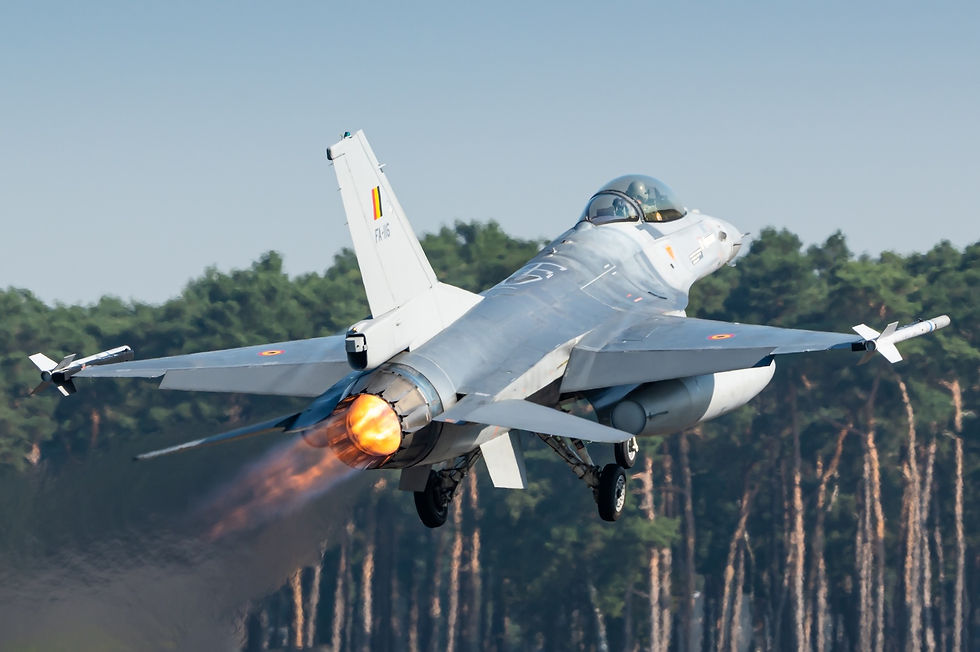
Continuous autofocus is essential. Set your camera to AF-C (Canon) or AFC (Nikon/Sony) mode. Use zone focusing or expanded point focusing rather than single-point AF, as this gives the autofocus system more information to track the moving subject. Enable subject tracking if your camera offers aircraft or vehicle detection. These AI-powered systems dramatically improve tracking success rates with fast-moving subjects. For extremely fast or erratic movements, some photographers prefer back-button focus, which separates focusing from the shutter release and provides more control over when focus is active.
Metering for fast-moving aircraft can be challenging due to rapidly changing backgrounds. Evaluative or matrix metering works well in most situations, but be prepared for exposure shifts when the aircraft moves from sky to ground or trees in the background. Some photographers prefer spot metering on the aircraft itself, particularly for white or light-colored jets that might otherwise be overexposed against a dark sky. Use exposure compensation to fine-tune your results, adding +0.3 to +1.0 stops for white aircraft against blue sky.

Be creative
Low angles make jets appear more powerful and dramatic, emphasizing their size and presence. Position yourself below the flight path when possible, shooting upward to silhouette the aircraft against the sky or capture the underside details. High vantage points offer unique perspectives rarely seen in military aviation photography. Elevated positions such as mountains or hills allow you to shoot down on aircraft, revealing top-surface details and markings. Intentional motion blur, achieved through slower shutter speeds while panning, creates images with tremendous energy. Experiment with speeds between 1/100th and 1/500th second, adjusting based on aircraft speed and distance. The goal is a sharp subject with streaked backgrounds that convey velocity. For an extreme effect, try slower speeds around 1/60th or 1/80th second. These require excellent panning technique but can produce striking abstract images where only portions of the aircraft remain sharp. Include environmental elements to tell a more complete story. Foreground elements like runway lights, ground crew, or airfield structures add context and scale. This approach works particularly well during taxi, takeoff, and landing sequences. Dramatic skies, whether storm clouds, golden hour colors, or stark blue contrast beautifully with military aircraft. Plan shoots around interesting weather conditions for more compelling backgrounds.
Silhouettes and Backlighting
Position yourself with the sun behind the aircraft to create dramatic silhouettes. Expose for the bright sky, rendering the aircraft as a dark shape. This approach emphasizes form and creates powerful, graphic images. During golden hour, backlighting creates rim lighting on the airframe, highlighting edges and creating separation from the background. This requires careful exposure to retain detail in the aircraft while preserving the warm background glow.

Pre-Visualization and Planning
Research the event or location beforehand. At airshows, obtain the flying schedule and display sequences. Understanding when and where specific aircraft will perform allows you to position yourself optimally and prepare mentally for the shots. Study the sun position throughout the day. Front lighting provides even illumination and saturated colors but can be flat. Side lighting creates dimension and drama through shadows. Backlighting offers creative opportunities for silhouettes and atmospheric effects. Fighter aircraft move quickly, so successful photography requires anticipating where the subject will be rather than reacting to where it is. Watch the aircraft's trajectory and predict its path. Start shooting slightly before the optimal moment, using continuous drive mode to capture a sequence. At airshows, pilots often repeat similar patterns. After observing one pass, you can better anticipate positioning for subsequent runs, selecting angles and backgrounds that enhance your composition.
10 Essential Tips for Fighter Jet Photography
Use Fast Shutter Speeds: Shoot at 1/1000th second or faster to freeze motion completely, or use 1/200th to 1/640th second while panning to create dynamic motion blur with sharp subjects.
Enable Continuous Autofocus: Set your camera to AF-C or AFC mode with zone or tracking focus. Use aircraft detection if available for dramatically improved tracking success.
Shoot in Bursts: Use continuous high-speed drive mode at 8-10 fps or faster. This increases your chances of capturing the perfect moment during fast-paced action.
Choose the Right Lens: A 100-400mm or 150-600mm zoom provides versatility for most situations.
Master Panning Technique: Track the aircraft smoothly from your hips, starting before it enters frame and continuing through the shot. Practice makes perfect for sharp subjects with blurred backgrounds.
Position for the Sun: Front lighting provides saturated colors, side lighting adds drama and dimension, while backlighting creates silhouettes. Plan your position based on sun angle.
Don't Fear High ISO: Use ISO 400-1600 or higher to maintain fast shutter speeds. Modern cameras handle noise well, and sharp images matter more than perfectly clean files.
Anticipate the Action: Study flight patterns and predict where aircraft will be rather than reacting. At airshows, watch the first pass to prepare for subsequent runs.
Shoot Low for Drama - Position yourself below the flight path when possible. Low angles make jets appear more powerful and impressive against the sky.
Include Context: Don't just zoom in tight every time. Capture environmental shots with dramatic skies, vapor effects, afterburner flames, or ground operations for a complete story.

Text & photos: Kris Christiaens


Comments